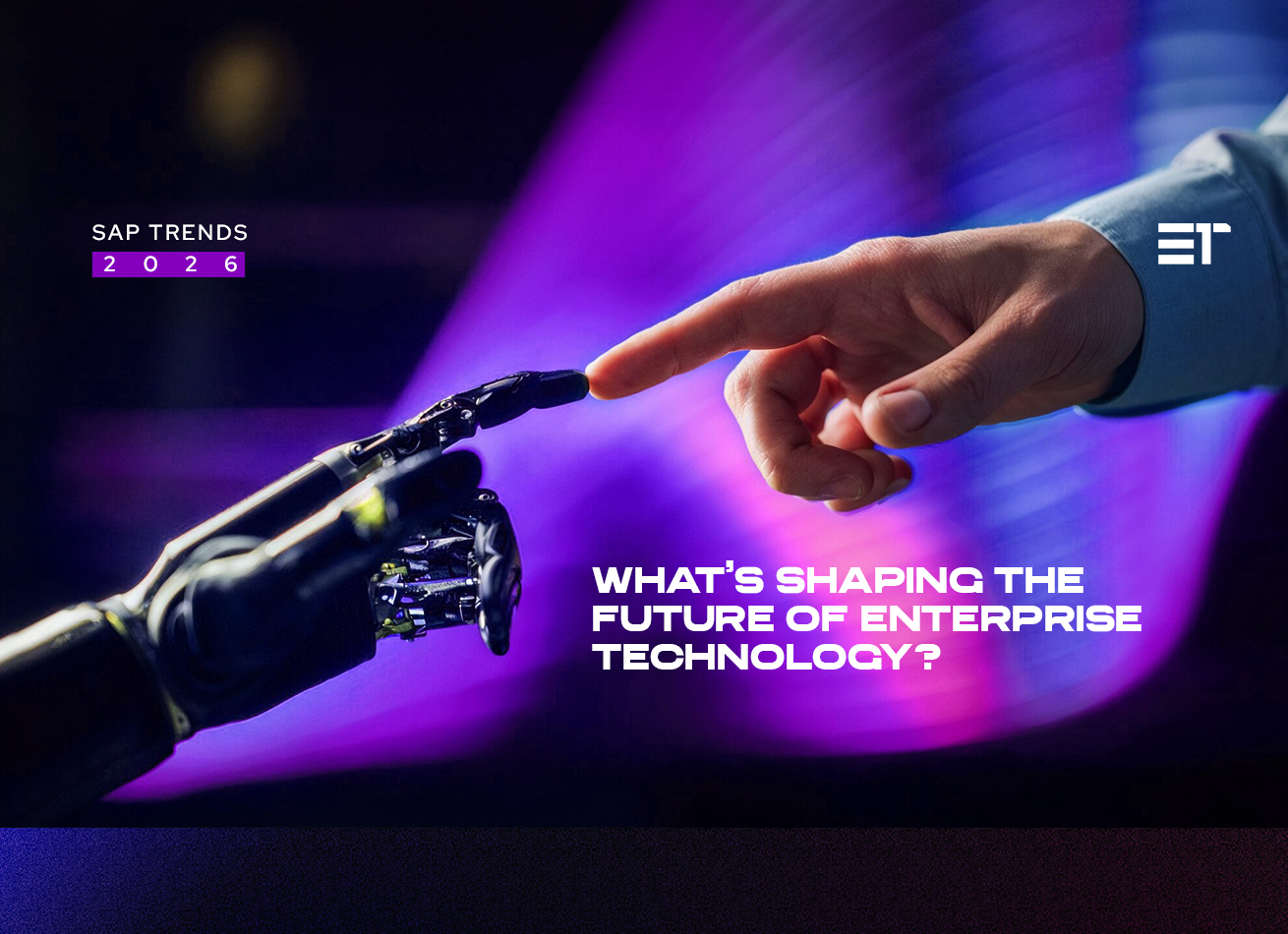
The SAP ecosystem is undergoing one of its most significant transformation cycles since the introduction of S/4HANA. As we approach the year 2026, the most prominent landscape SAP trends will focus on cloud migration, integrated AI, sustainability, industry offerings, and tighter governance.
Companies are modernizing their ERP environment in ways that fundamentally change the way they manage data, automate decisions, and provide real-time insight. Put simply, SAP in the year 2026 is much more than a place to run business operations; it’s a place to run intelligent, connected, sustainable business operations.
Why a Move to SAP S/4HANA Cloud is Crucial by 2026?
SAP has announced the end of mainstream maintenance for ECC by March 2027, placing the year 2026 as the final complete year to plan migrations. Organizations are adopting S/4HANA Cloud centred on a “clean core” strategy, which emphasizes standard processes thinking while minimizing customizations.
In practice
- Organizations are moving to RISE with SAP, which combines ERP, cloud infrastructure, and transformation services into one contract.
- A “clean core” allows organizations to maintain flexible systems, curb technical debt, and make future upgrades as simple as possible.
- Organizations can extend the functionality people use via BTP instead of modifying the core code.
This describes the essence of most SAP technology trends: because innovation, analytics, and AI require cloud-based infrastructure.
In What Way is AI Reshaping SAP Solutions in 2026?
AI will be integrated into SAP applications by 2026 instead of simply being embedded as additional functionality. The vision for SAP trends is for “intelligent processes” that are able to consider their surroundings and act independently.
Examples:
- SAP Joule, the digital assistant using generative AI to summarize insights and respond to natural-language questions
- Finance automation, that’s AI-enabled, predicting cashflow, accelerating closure and highlighting anomalies in the moment
- Procurement and supply chain solutions, using predictive analytics to improve inventory and demand forecasting.
SAP trends are moving away from process automation to process intelligence – enabling SAP systems to learn from patterns in data and continuously optimising the workflows.
What Does “industry-specific SAP” Mean in 2026?
One of the biggest latest tech SAP trends is deep verticalization – the development of industry cloud solutions that are fitting for industries. SAP has provided industry capabilities in areas such as manufacturing, life sciences, utilities, and retail. By 2026, you should expect substantial things related to this:
- Pre-packaged business content that relates to industry functionality that will drive a quicker time-to-value.
- Integration of industry and horizontal processes, i.e., joining clinical trials with finance or the sustainability metrics for retail logistics.
- Partner ecosystems that provide industry-specific extensions from SAP’s BTP Marketplace.
Driving this means that the company can continue to run a standard ERP that is configured with its industry logic with limited customization but also improve the level of complexity as the business’ needs evolve to support scale and ROI.
How is Data and Analytics Changing in SAP Ecosystems?
SAP is moving toward real-time, embedded, and predictive analytics. With S/4HANA and SAP Analytics Cloud, users can view situational insights right from within their operational screens — no report or export needed.
By virtue of SAP Trends 2026:
- Organizations will rely on live data connections through HANA Cloud, eliminating truly siloed data.
- Predictive analytics will fully integrate scenario simulations and what-if analysis into finance and supply chain scenarios.
- Augmented analytics will leverage machine learning to offer actions, not just insights.
In short, analytics in SAP is shifting from descriptive dashboards to decision intelligence, with the intent to help you act — not just analyse.
Why are Security and Compliance at the Forefront of SAP’s 2026 Roadmap?
With the shift to cloud and interconnected applications, security and compliance have emerged as SAP’s core priorities. With SAP trends 2026, SAP GRC for HANA and advanced identity management will bring together governance experiences across the premise and cloud landscapes.
Some areas of focus are:
- Continuous compliance in industries at the highest level of regulation (finance, pharma, public sector).
- Real-time access control and risk mitigation with integrated business processes.
- Automated audit and transparency provided in the handling of data on the application layer.
For global enterprises, security is quickly becoming a value enabler, establishing trust and resilience while supporting acceleration in the digital transformation experience.
What Impact will Hybrid and Multi-cloud Paradigms Have on SAP Landscapes?
In 2026, taking SAP to a single environment will be performed only by very few companies. The hybrid and multi-cloud paradigms are now the norm.
Businesses can leverage SAP’s partnership with AWS, Azure, and Google Cloud to ensure workloads are optimized for the environment:
- Core ERP can execute in a private cloud for governance reasons.
- Analytics and AI can run in public clouds for scaling and on-demand hybrid consumption.
- Integration and API can advance in SAP’s BTP with mobility.
Packaging workloads in multi-cloud solutions gives the customer the best of agility, cost, and control to choose the best environment for each workload.
What is Sustainability’s Role in SAP’s Future?
Sustainability is no longer an option, but is hard-coded into SAP’s product innovations and corporate strategies. By 2026 nearly all new SAP technology trends will come with ESG and Circular Economy innovation as a norm.
Customers can:
- Model the tracking of carbon emissions within the supply chain.
- Analyse a product’s lifecycle impact on resource efficiency.
- Integrate sustainability measures with financial KPI’s for inclusion in reporting.
SAP’s innovation of a green ledger is an example which connects the elements of environmental data into the financial system for CFOs to evaluate profit and planet. This is one of the strongest SAP trends in 2026 and represents technology working in conjunction with corporate responsibility in the long run.
How will Skills and Change Management Impact SAP Success in 2026?
Technology in and of itself does not create transformation. Rather, the viability of these SAP trends depends on the employee, their skillsets, willingness to adapt, and ability to change.
By 2026:
- SAP professionals will require cross-domain knowledge: data science, process intelligence, and cloud architecture.
- Companies will focus on continuous learning and policies for certification on S/4HANA Cloud, BTP, and AI integration.
- Change management programs will be essential in every transformation project – identifying the user, training them up, and aligning with the culture.
In this age of AI and automation redefining work, people are SAP’s most valuable asset.
How Should Companies Prepare for SAP Trends 2026 and Beyond?
If you are mapping your SAP roadmap to 2026 – practical approaches include:
- Understanding your current state: What’s on ECC, what’s in cloud, what needs to modernize?
- Building migration strategy: Greenfield or brownfield – based on your business outcome objectives.
- Embracing a clean core mentality: Innovate with BTP instead of customizing your ERP core.
- Investing in AI and analytics: Start small and with embedded use cases in finance or operations.
- Focusing on governance and security: Build compliance into every process.
- Tracking sustainability impact: Build ESG data into your reporting framework.
- Empowering your people: Aim for the new SAP trends of 2026 — automation, data literacy, and strategic thinking.
What Do SAP Trends Look Like in 2026?
The trademark of SAP trends in 2026 is intelligence everywhere — from workflows and data models to sustainability tracking and compliance.
SAP’s journey to transform from a transaction-based ERP platform into an intelligent, adaptive enterprise platform is changing the way we operate a business. It will be the ones who migrate early, responsibly embrace automated data, and create a culture that finds synergy between technology and human interpretation that will win.
In summary, SAP trends in 2026 aren’t just about another system, they are about an ecosystem of intelligence, sustainability, and agility that will support the next generation of business.