ERP was not always as powerful business platform as it is today. Primarily, ERP focuses on manufacturing, but now ERP has become the digital core of modern enterprises. Today, ERP brings together almost all the business functions of finance, inventory, sales, procurement, HR, and operations, giving organizations a single source of truth and the real-time insights needed to make faster, more informed decisions.
The evolution of ERP reflects how business needs have changed with time. It also reflects how ERP evolution has transformed business software from standalone applications into intelligent, connected platforms. With this advancement in ERP industry, next generation ERP solution like SAP offers greater flexibility, automation, and scalability. This shift allowed modern ERP for small businesses to be more accessible than ever, while shaping the future of ERP systems.
At Elevra Tech, we work with businesses that are either replacing outdated systems or implementing ERP for the first time. In this guide, we’ll explore the complete history of ERP, the key milestones that shaped ERP evolution, and what modern ERP for small business looks like today, and where it’s headed next.
What Is ERP, and Why Does Its History Matter?
ERP wasn’t always the comprehensive business platform it is today. It has continuously adapted to changing business needs. Today, it is defined as a framework that connects essential business functions of an enterprise.
Over time, ERP evolution transformed systems into act intelligently that connect every business function. From accounting and inventory to sales and procurement, from manufacturing to customer management, ERP ensures every department works with the single source of truth. Understanding the evolution of ERP makes it clear why legacy software is being replaced by next generation ERP solutions like SAP. The evolution of ERP has reshaped how enterprises operate and continue to influence the future of ERP systems.
The History of ERP: A Decade-by-Decade Journey
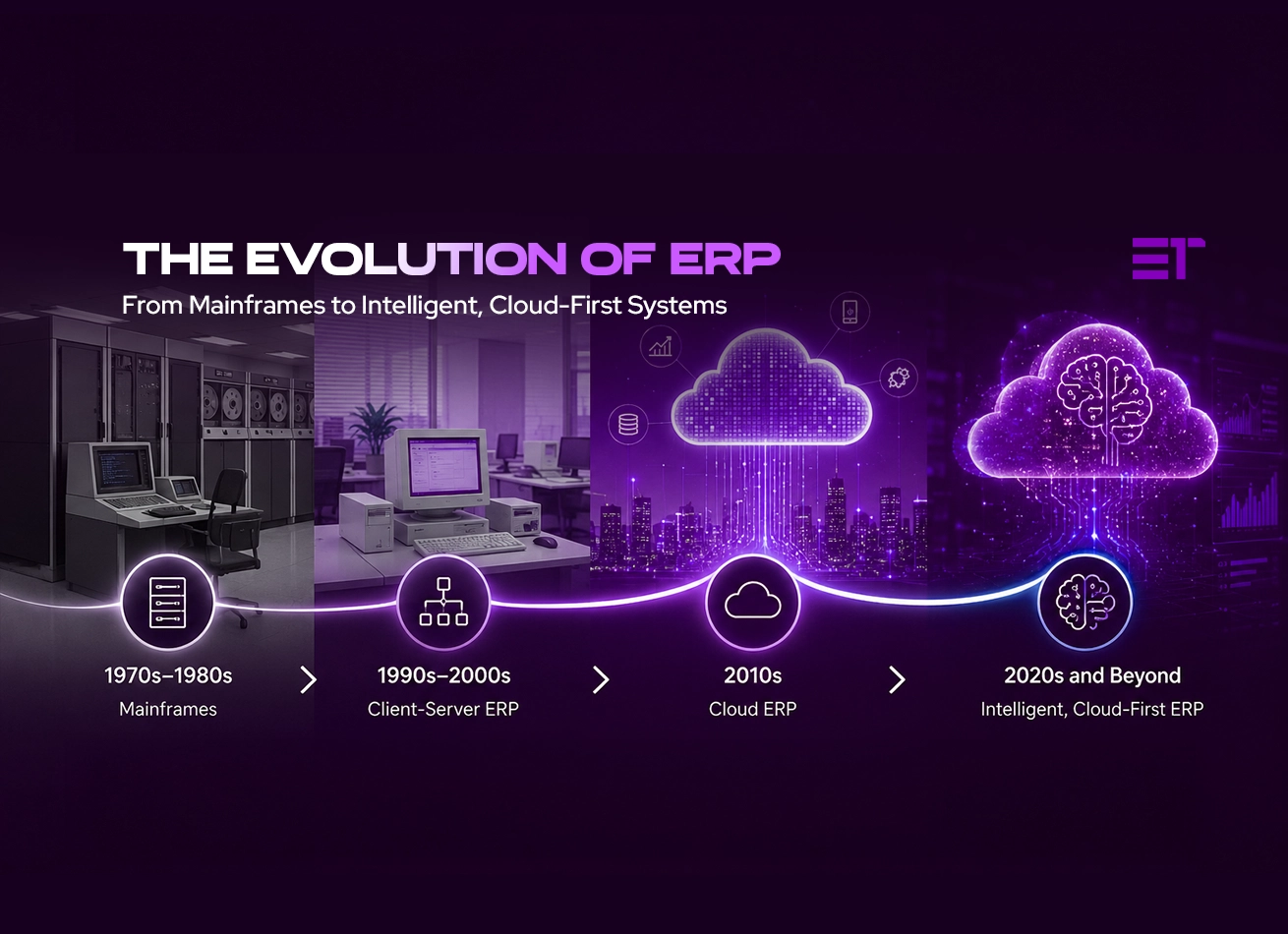
The 1960s and 1970s: MRP Marks the Start of ERP Evolution
The history of ERP started with Materials Requirement Planning (MRP), where a system was developed to help manufacturers plan production, schedule and manage raw material and inventory more efficiently. At that time, MRP software operated on expensive mainframe systems. Since, it was not pocket friendly, therefore it was primarily adopted by large manufacturing organizations only. Even so, this milestone in the history of ERP paved the way for next generation ERP solutions that support finance, sales, procurement, and operations on a single platform.
The 1980s: Manufacturing Gets Smarter with MRP II
The arrival of Manufacturing Resource Planning (MRP II) in the 1980s transformed how manufacturers managed their operations. Unlike its predecessor, MRP II managed not only materials but also shop floor activities, production schedules, and manufacturing capacity. Though still manufacturing-centric, MRP II represented a significant step in the evolution of ERP system, paving the way for the integrated business solutions organizations rely on today.
The 1990s: Enterprise-Wide Integration Becomes Reality
The launch of integrated ERP platforms in the 1990s changed the business software forever. For the very first time, businesses could now manage procurement, finance, manufacturing, and sales, human resources through a single, integrated platform instead of using separate applications. This laid the foundation for next generation ERP solutions. The ERP solutions improved collaboration across departments, but the implementation costs meant the technology remained largely limited to large organizations.
The 2000s: The Shift Toward Digital ERP
The rise of the internet accelerated the evolution of ERP system technology. Organizations could now access ERP systems through web browsers. They can have stronger collaboration across the supply chain, and better integration with digital commerce platforms. While this phase of the evolution of ERP system made business operations more connected and collaborative, but many solutions were still depended on expensive on-premises infrastructure and complex implementations.
The 2010s: ERP Moves to the Cloud
The 2010s is one of the most significant milestones in the evolution of ERP with the widespread adoption of cloud computing. The businesses no longer had to manage on-premises infrastructure or long and cumbersome software upgrades. This phase of the evolution of ERP system reduced upfront costs, simplified maintenance, and accelerated implementation. Such transformation not only accelerated ERP evolution but also established modern ERP for small business as a viable and cost-effective solution.
The 2020s: Shaping the Future of ERP Systems
The history of ERP has reached an exciting new phase, where intelligence is built into the system itself. Today’s ERP platforms do far more than storing business data. They leverage AI, machine learning, predictive analytics, and automation to simplify operations and deliver actionable insights in real time. Such advancements represent the next phase of ERP evolution system, therefore making next generation ERP a quintessential tool for organizations to achieve agility, efficiency, and sustainable growth.
Why ERP Continues to Evolve?
Though, technology did play a major role, in taking ERP from on-premises systems to cloud-based, and AI-enabled platforms. But the evolution of ERP has never been driven by technology alone. It has been shaped by how businesses operate. Even more reasons for its’ accelerated evolution are growing operational complexity, digital transformation, and the demand for faster decision-making. Today, modern ERP for small business offers capabilities that were once available only to large enterprises. These changes continue to shape next generation ERP and making advanced capabilities accessible to businesses of every size.
What Defines Next Generation ERP?
The history of ERP has transformed enterprise software drastically. There were times when enterprises used software only as basic operational tools rather than as intelligent business platforms. The next-generation ERP solutions combine cloud-first architecture, AI-powered automation, real-time analytics, and seamless integrations to help businesses operate more efficiently.
Essential features of modern ERP include –
- Cloud-based architecture for flexibility and security
- Artificial intelligence and machine learning capabilities
- Seamless integration with CRM, e-commerce, and industry tools
- Flexible, scalable modules that support future growth
- Real-time dashboards and performance reporting
- Mobile access for remote teams
Platforms such as SAP Business One offer modern ERP for small businesses without the complexity of traditional enterprise software.
Why Modern ERP for Small Business Is a Smart Investment
One of the biggest positive advantages of the evolution of ERP is that advanced business software is no longer limited to large enterprises. Modern ERP for small business gives growing companies access to cloud technology, AI-powered features (intelligent automation and real-time insights), and subscription-based pricing that supports faster growth and better decision-making.
Some of the key advantages include:
- Lower ownership costs with cloud deployment
- Real-time visibility across departments
- Faster implementation as compared to traditional ERP deployments
- Scalable modules that support future growth
- Reduced reliance on spreadsheets and disconnected software
What Does the Future of ERP Systems Look Like?
The evolution of ERP is far from over. It is now entering a new era driven by AI, automation, and cloud innovation. The next generation of ERP platforms will not only manage operations but will help organizations predict outcomes, automate decisions, and continuously optimize performance.
Some of the biggest trends include:
- AI-assisted decision-making by automating business processes.
- Personalized user experiences based on roles and responsibilities.
- Industry-focused ERP capabilities designed for specific business models.
- AI-powered forecasting for demand planning, cash flow, and risk management.
This next phase in the evolution of ERP system is making next generation ERP smarter. Both large enterprises and small businesses can take advantage of such intelligent, scalable, and future-ready ERP solution.
Final Thoughts
The evolution of ERP system is more than a story of advancing technology. It has transformed drastically the enterprise software from just manufacturing planning tool to an intelligent business platform that drives growth, agility, and innovation. By knowing the history of ERP, we have seen why businesses are now replacing legacy systems with flexible, AI-enabled ERP solutions. At Elevra Tech, we help businesses make that transition with SAP Business One simple and easy.