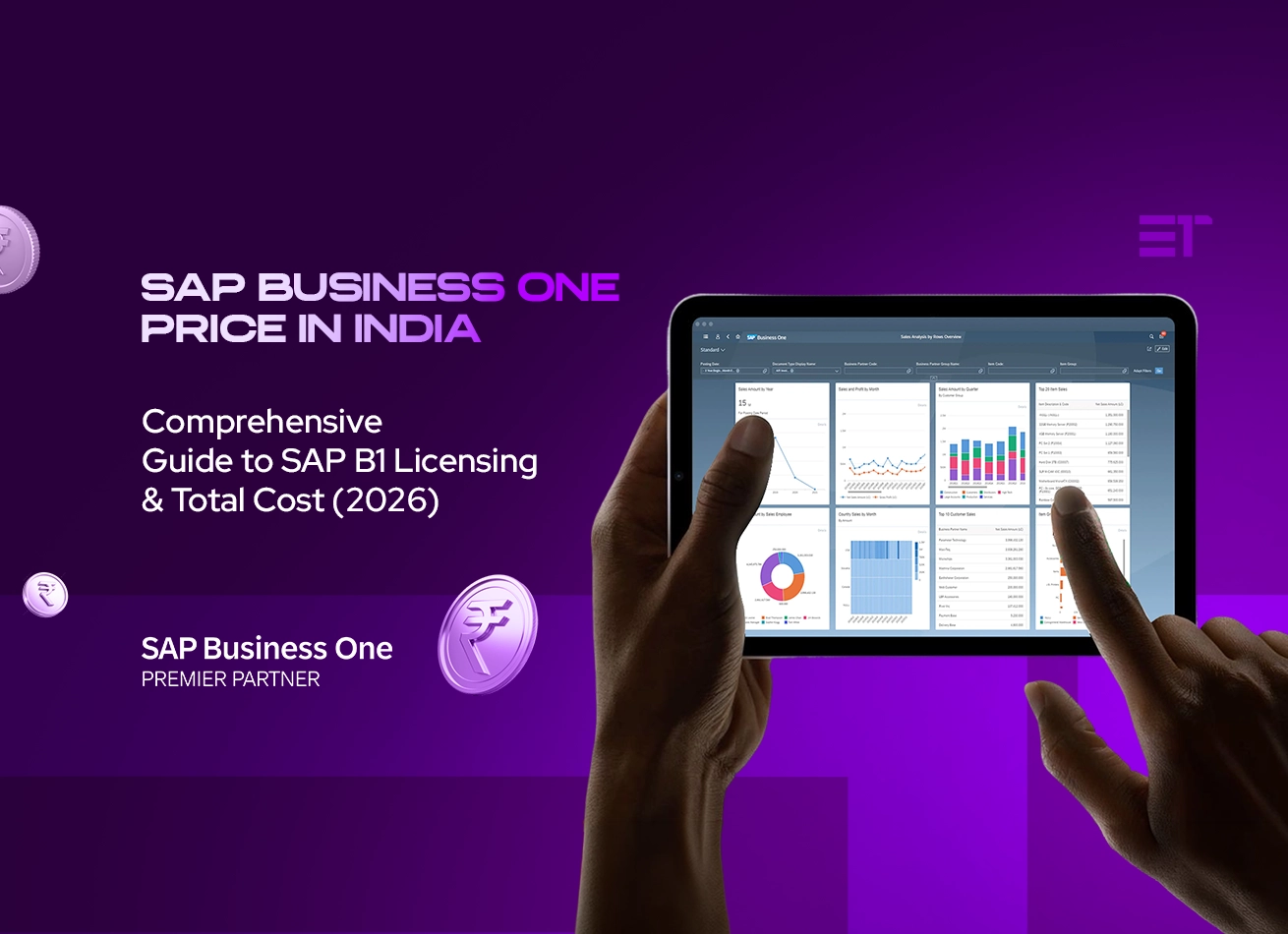
For most Indian small and medium businesses, investing in an ERP solution is one of the crucial decisions of their existence. When it comes to ERP, it is hard to ignore SAP Business One or SAP B1. However, prior to making a commitment to SAP Business One, the question that inevitably arises for almost every company is: what is the SAP B1 price in India?
Unfortunately, there isn’t any standard SAP Business One price in India. There are too many factors that define the price you end up paying. These may include, among others, the number of users, license model, implementation strategy, degree of customization, etc. In this guide, we break down everything you need to know about the SAP B1 total cost, SAP B1 licensing cost India, and the SAP Business One implementation cost to help you budget correctly and optimize your ERP investment.
Why Understanding the SAP Business One Price in India Is Important?
It happens quite often that Indian SMEs limit themselves to assessing the SAP Business One price in India in terms of license fees when budgeting an ERP investment. As practice shows, the actual SAP B1 total cost involves more components, including but not limited to implementation, customization, user training, hosting, and add-on licenses. Failing to budget these additional elements of the cost structure means risking unexpected financial hits in future.
SAP’s success with India’s small and medium businesses is because the company provides enterprise-level ERP functionality coupled with a commercially convenient price structure for the Indian SME market. Compared to international benchmarks, the SAP B1 licensing cost India is relatively lower which contributes to the widespread adoption of SAP B1.
Main Elements of the SAP B1 Total Cost Structure
As already mentioned above, the total cost structure of SAP B1 includes a variety of components. Below, let us take a closer look at these elements and explain how they impact your total investment in the ERP solution.
- Licenses Fees (SAP B1 Licensing Cost India)
The price that you are to pay for SAP B1 licenses is influenced by several factors:
- Type of license – professional, limited, starter package, or indirect access
- Type of license agreement – perpetual vs. subscription
- Number of users
- Volume discounts (available for large-scale orders)
Every type of license is intended for a certain category of users who have specific access rights to SAP Business One modules. Using the most appropriate license structure is the main driver that makes it possible to decrease the SAP B1 licensing cost India to the minimum level. Inadequate allocation of user licenses is one of the most common reasons behind unnecessarily high costs of implementation.
- SAP Business One Implementation Cost
Implementation is a crucial part of SAP B1 deployment that often gets underestimated. According to estimates, it can account for a significant part of the Year 1 budget – sometimes even comparable to the cost of software licenses.
The cost of SAP B1 implementation includes multiple steps and activities like business process mapping, software configuration, migration of master data, system customization, integration with third-party solutions, user training, user acceptance testing, and controlled go-live. Complexity of the process varies based on the characteristics of your business.
- Annual Maintenance Charges (AMC)
In the context of perpetual license agreements, the SAP B1 licensing cost India usually includes a part of the fee designated for AMC which covers software updates, bug fixes, and access to additional modules.
- Hosting and Infrastructure
SAP Business One supports both on-premise and cloud deployment models that differ in cost structure. When going for cloud hosting, the overall cost of SAP B1 is split into the SAP Business One price in India and monthly subscription fees. This approach makes it easier to budget an ERP investment since you are aware of what exactly you will be charged.
On-premises deployment requires the setup of an in-house server, database licensing, and a corresponding infrastructure. Though the upfront cost is higher, it is usually accompanied by lower variability in operational expenses.
- Add-Ons, Customizations, and Training
The SAP B1 licensing cost India doesn’t account for the price that you need to pay for purchasing add-ons which are necessary for industries like pharmaceuticals, automotive, or electronics. In addition, depending on the level of customization that you require, the SAP Business One implementation cost will vary. Training sessions also affect the total price you will pay for SAP B1.
SAP Business One Price in India Based on Business Size
Though individual cases of SAP Business One cost calculation may vary, the rule is quite clear: as a company scales, both the SAP B1 licensing cost India and SAP Business One implementation cost increase. The number of users is certainly not the only factor affecting the increase in the total cost of ownership as more complex integration and greater customization needs are expected at later stages.
| Business Profile | Main Driver of SAP B1 Total Cost |
|---|---|
| Micro / Startup | Limited user count, standard configuration, cloud-first |
| Small Business | Moderate user count, light customization needs, cloud-first |
| Mid-Sized Business | Multi-department structure, multiple integrations, multi-location |
| Large SME / Group | Complex processes, consolidation, group accounting, multi-channel |
Rather than trying to find out some standard figures, it is much more effective to contact a certified SAP Business One partner with your details and request a quote for the SAP Business One price in India.
Perpetual vs. Subscription Licenses and Their Impact on SAP B1 Total Cost
Depending on whether you choose a perpetual license or subscribe to SAP B1, the long-term SAP Business One price in India will vary considerably.
Perpetual License Agreement (CAPEX)
With a perpetual license agreement, you acquire ownership of software which means that you pay one time to buy licenses. This model allows saving money on SAP Business One cost over time since you only pay once for licenses.
Advantages of Perpetual Licenses:
- Fixed SAP B1 total cost due to lack of recurring payments
- Ideal for those who need a perpetual software license
- No license escrow needed
Disadvantages of Perpetual Licenses: - Need to renew the license for additional users
- More expensive compared to subscriptions
Subscription License Agreement (OPEx)
Subscription licenses allow subscribing to the software instead of buying. With a subscription license, you regularly pay a recurring fee in exchange for regular updates and additional features.
Advantages of Subscription Licenses:
- Lower upfront SAP B1 total cost
- Easy to scale in case of growth
Disadvantages of Subscription Licenses: - Renewal every year
Strategic note: Subscription is better if you are still growing. As a result, the SAP B1 price in India will remain at relatively low levels in Year 1 – Year 3.
Underestimated Factors That Affect SAP B1 Total Cost in India
There is several aspects that affect SAP Business One implementation costs and should be considered during budgeting. Here is a list of under-budgeted elements of SAP B1 total cost:
- Over-licensing: assigning more permissions than necessary to certain employees results in increased cost.
- Unused add-ons: the inclusion of unnecessary modules leads to inflated cost.
- Consultant and advisory fees.
- Data migration issues.
- Customization needs and requests.
- Annual escalation of subscription cost.
How to Budget the SAP Business One Cost Effectively in India
Below, we discuss seven tips for controlling SAP B1 cost that are used by many Indian SMEs.
- Before purchasing the product, perform a license audit and try to reduce the cost of licenses you buy.
- Negotiate volume discount to receive better conditions.
- Go for a cloud deployment model.
- Work with a certified SAP partner with strong experience.
- Phase your project to spread SAP Business One implementation cost across a few fiscal periods.
- Avoid unnecessary customization of the software as much as possible.
- Regularly review usage of licenses and adjust accordingly.
Finding the Right Partner for SAP Business One Implementation in India
A key factor that determines your final cost of SAP Business One implementation is the partner with whom you choose to work. Some providers give low quotes but charge a lot of money when implementing SAP B1. Others charge higher fees but deliver projects successfully and on time.
When looking for a suitable partner, you might want to ask the following questions:
- Is your provider certified by SAP India?
- Are you able to provide a fixed-scope implementation quote?
- What is the implementation cost for SAP B1 per module?
- How many SAP B1 customers do you have in my industry?
- How fast can you deploy SAP Business One?
- Do you offer post-implementations services like AMC, support, and continuous improvement?
Is It Worth Buying SAP Business One at the Given Price in India?
SAP Business One is one of the best ERP solutions on the market that is capable of helping businesses to manage their operations more efficiently. For most Indian companies, the return on investment in SAP B1 occurs one-two years after deployment. This is when benefits of the product become evident thanks to improvements in:
- Order-to-cash cycles
- Inventory control and management
- Working capital management
- Financial reporting capabilities
- Compliance with local legislation, including GST and e-invoicing
- Integration opportunities
If compared to a conventional ERP alternative like Tally integrated with Excel, Google Sheets, and other add-ons, the cost of owning SAP B1 in India is considerably lower. Furthermore, SAP is actively investing in the development of AI-powered technologies, which makes SAP B1 even more valuable to use.
Final Words About SAP B1 Cost
When budgeting the price of SAP Business One in India, you shouldn’t focus exclusively on licenses. The cost of deploying the ERP solution includes more elements: SAP B1 licensing cost India, implementation cost, annual maintenance charges, and hosting. By thoroughly understanding all of these, you will be able to plan your budget appropriately.
For those who decide to implement SAP Business One, here is what to remember about choosing the right approach: first of all, map your user needs and determine what you really need from the product. Then, reach out to a certified SAP partner who will calculate your SAP Business One price in India based on your individual needs.
Frequently Asked Questions (FAQs)
How is the SAP B1 price in India defined?
The main elements that determine the cost of implementing SAP B1 are the number of users, types of licenses that you buy, type of deployment, and the degree of customization. A detailed assessment will help you calculate SAP B1 price in India accurately.
What is the difference between the cost of licenses and implementation?
The SAP B1 licensing cost India is the amount of money that you pay for the software itself. As for the SAP B1 implementation cost, it is related to the process of installing and configuring the product. Both fees contribute to the SAP B1 total cost.
Is it cheaper to implement SAP B1 in cloud or on-premises mode?
Though the choice of the model depends on individual business specifics, the fact remains that most Indian companies opt for cloud deployment as it enables budgeting SAP Business One cost accurately and quickly getting a return on investment.
Can SAP B1 implementation cost be minimized?
Of course, it can be done in several ways like phasing the deployment, balancing license fees, and choosing the most experienced partner.
Identify three primary challenges during SAP Business One AI adoption.
The three primary implementation challenges for mid–market enterprises include data readiness, change management, and iteration process. Data readiness refers to the readiness of organizations to integrate SAP Business One AI when they have efficient Master Data Management and data entry capabilities. Change management involves convincing employees to embrace AI recommendations. This is made possible through explaining AI reasoning methods and identifying which tasks should be handled by machines and which ones by human beings. Lastly, mid–market firms should not aim at perfectness at first but focus on iteratively refining ML algorithms.